Bluewater builds 200 MW campuses inside proven offshore concrete towers — cooled by the sea, powered by onboard nuclear modules or from shore, and maintained by technicians who take an elevator, not a submarine.
Northern Virginia, Santa Clara, Phoenix, Atlanta — the grid queues run two to four years, the land is gone, the water is contested, and the neighbors are organized. Capital is available; buildable megawatts are not. Twenty-five miles offshore sits a site with unlimited room, 50–54 °F cooling in every season, no neighbors within earshot — and no interconnection queue.
Interconnection waits in the major metros now exceed typical build schedules — power, not capital, sets the pace.
A 200 MW campus needs contested metro land, rezoning, and years of hearings. Offshore, the footprint is a 3-acre seabed lease.
Evaporative cooling at this scale consumes a small city’s water. The ocean takes the same heat without losing a gallon.
Cooling-plant noise is now a leading cause of data-center opposition. At sea, the nearest bedroom window is 25 miles away.
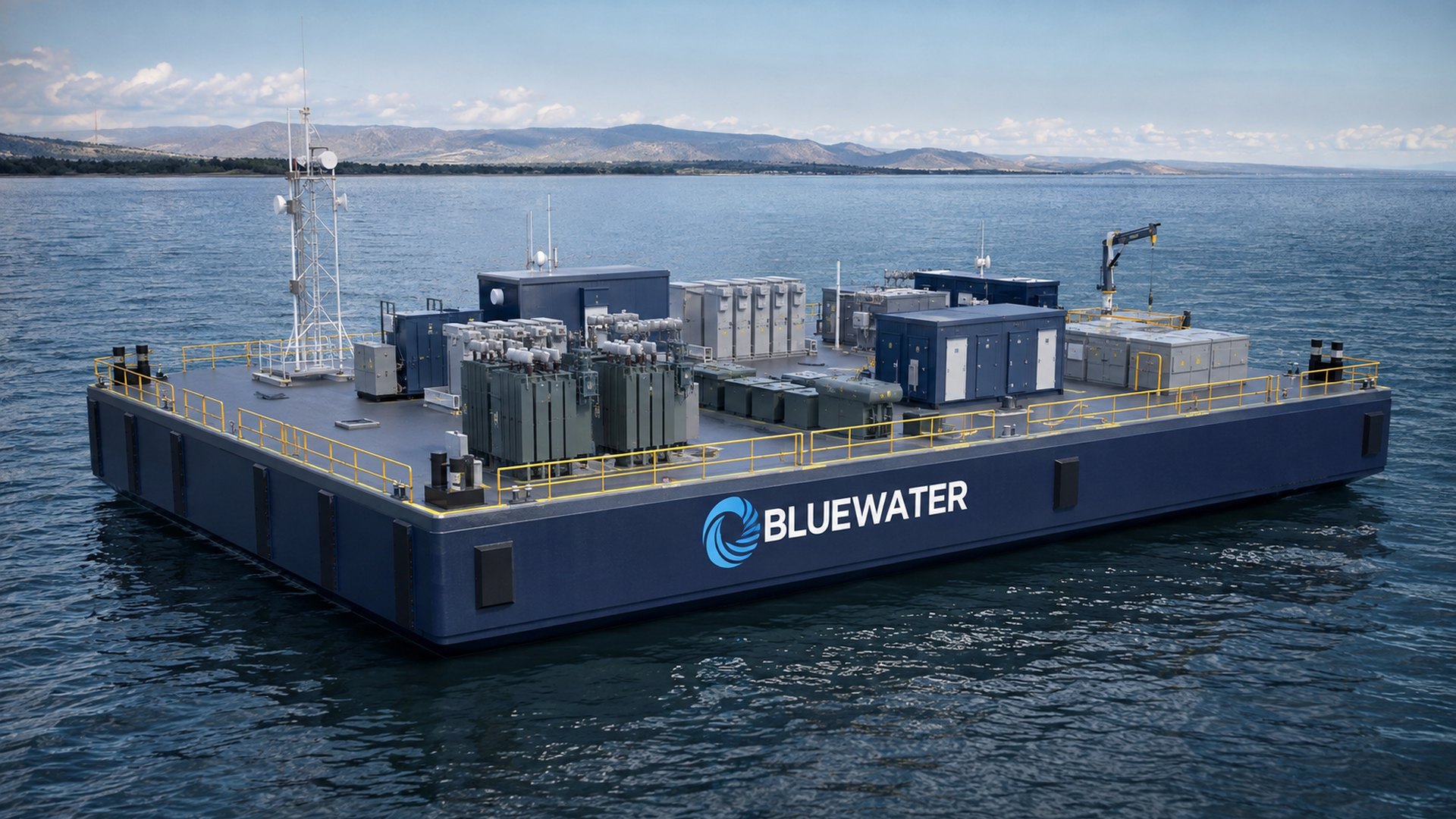
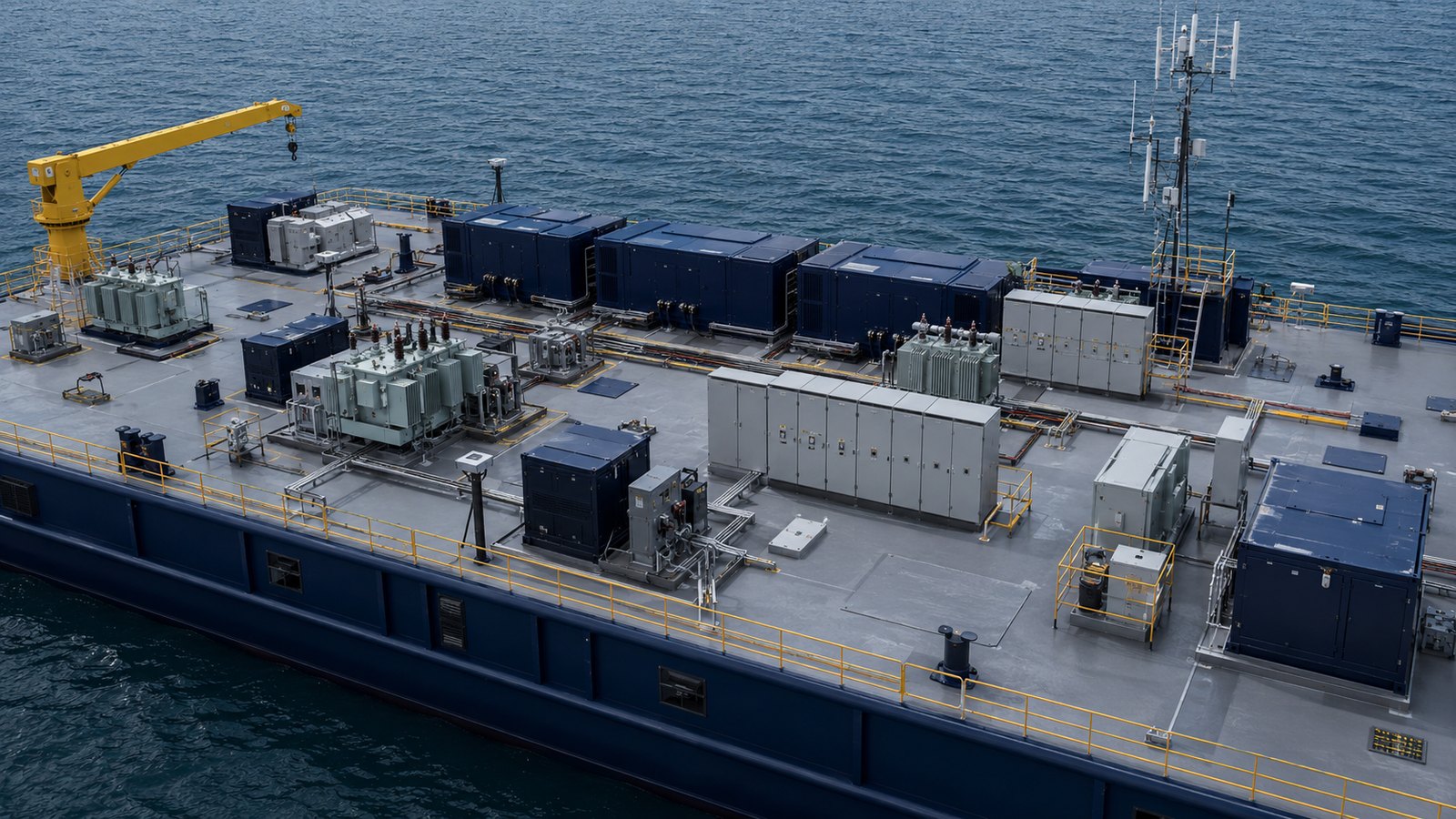
Everything above the waterline: substation, control room, helideck — and, as an option, four Xe-100 small modular reactors delivering 320 MWe with N-1 redundancy. The tower runs unmanned, operated from shore.
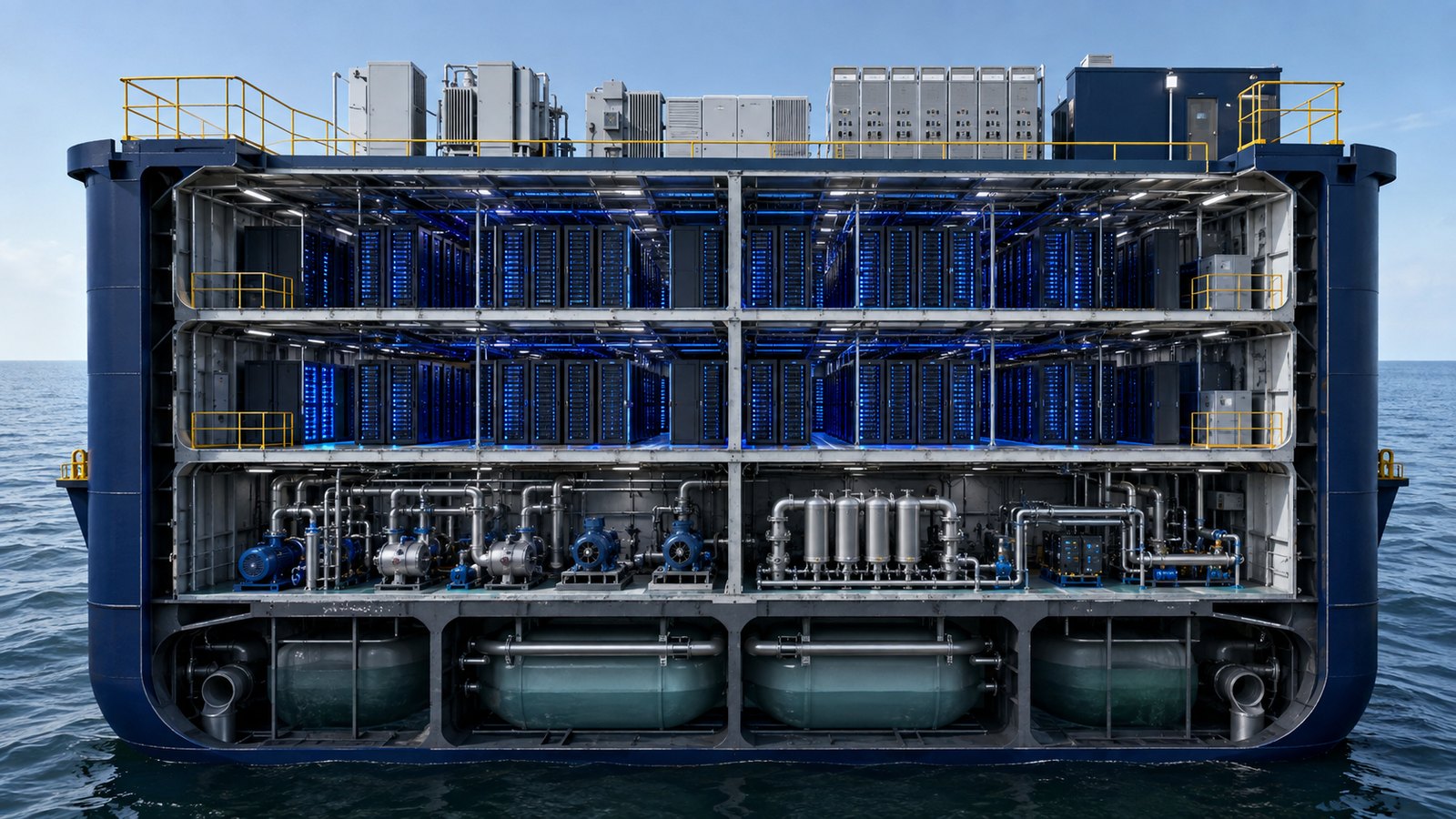
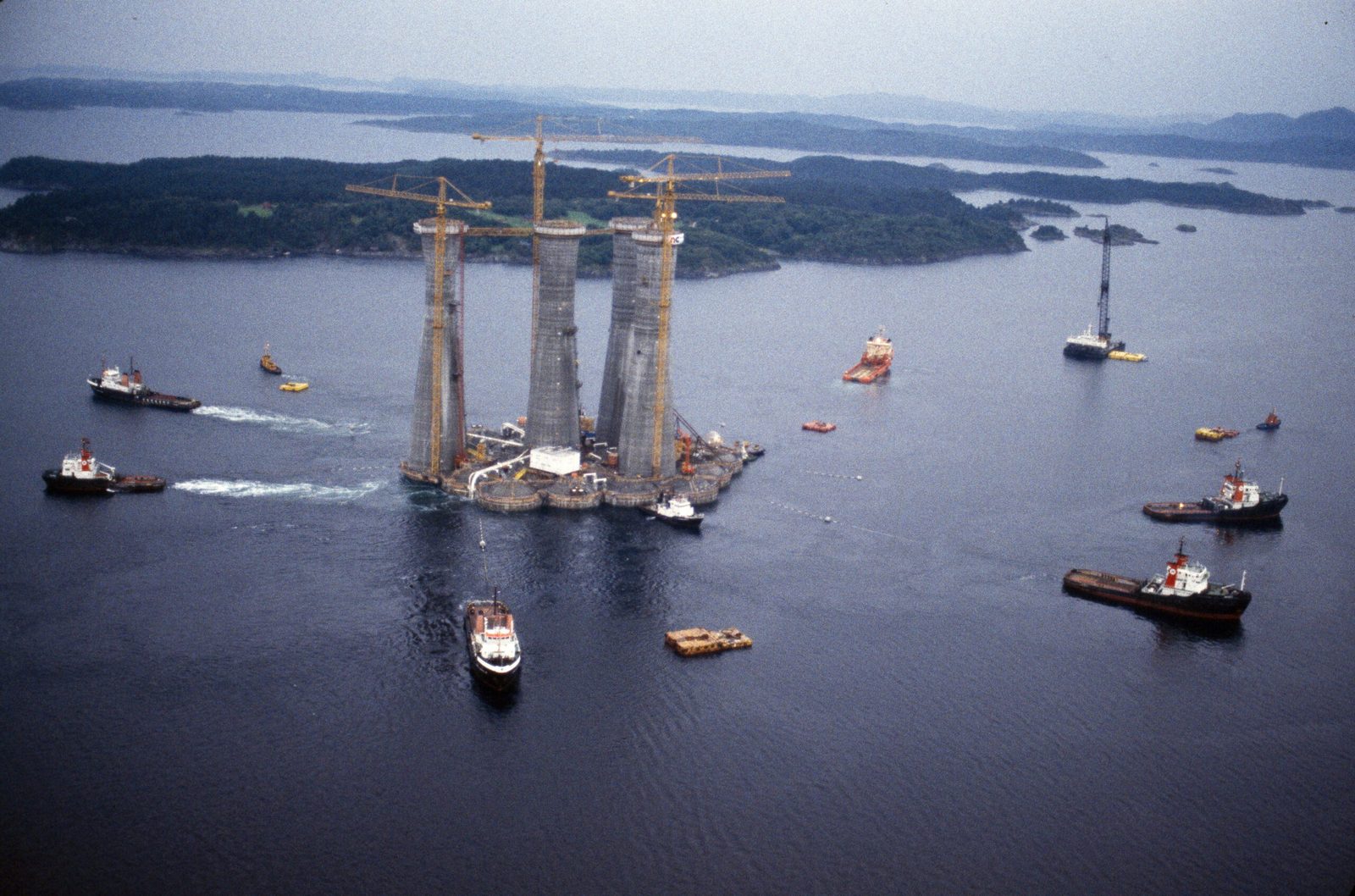
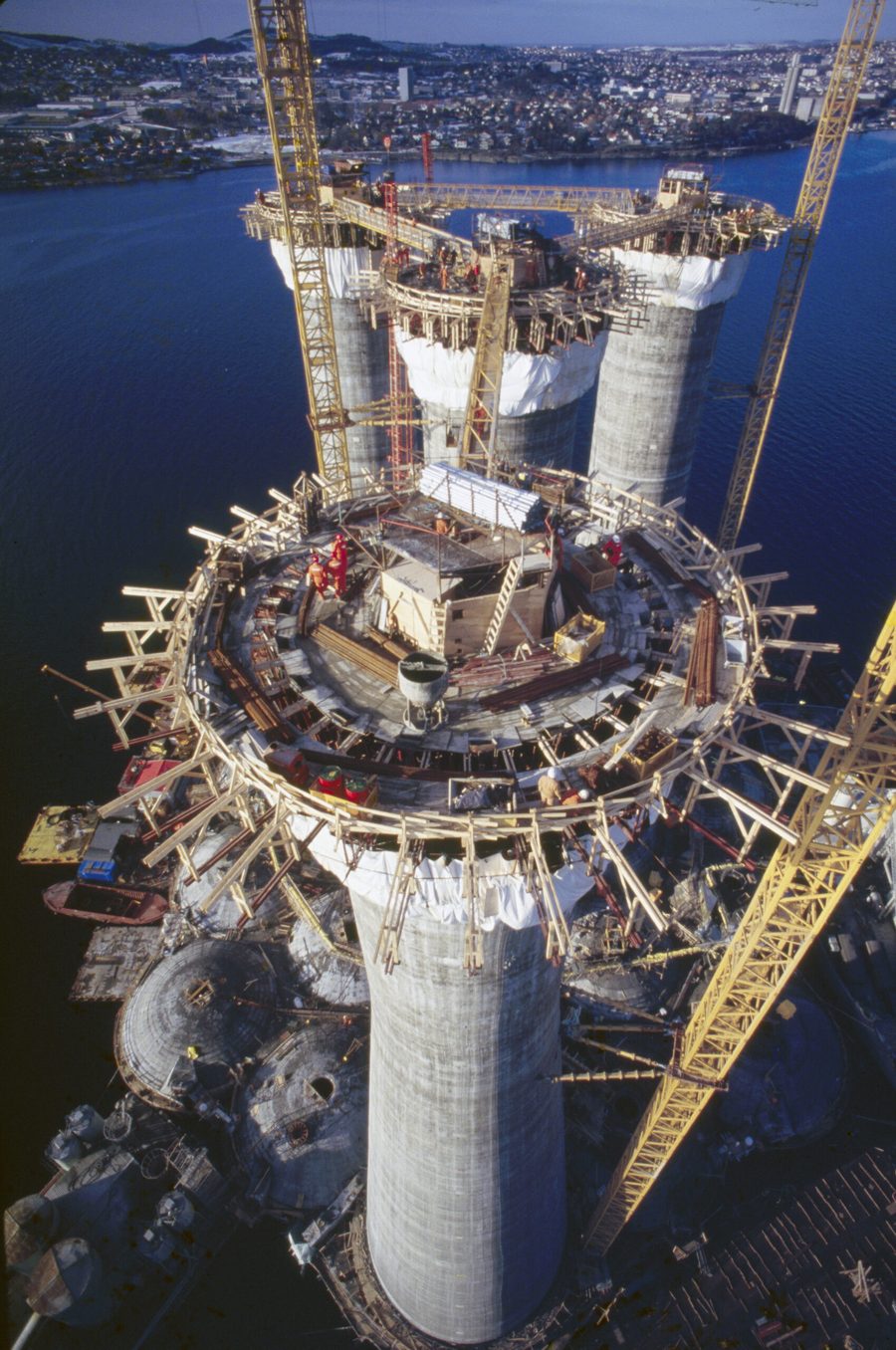
Four Gullfaks-class concrete shafts — 98 ft across at the base, 46 ft at the top — carry the entire 200 MW from day one. Halls are sealed in dry nitrogen; a pressurized core with passenger and 5-ton freight lifts keeps every rack an elevator ride away.
Standardized 52 ft concrete spheres winch onto shaft saddles as 10 MW growth modules — the water pressure loads the shell in pure compression, so the hull gets stronger the deeper it sits. Expansion to 290 MW without touching the tower.
A cellular concrete caisson, ballasted down onto the seabed — no piles, no anchors, no heavy-lift vessels. The same gravity-based design has held ~30 North Sea platforms in place for fifty years. Pump rooms here draw 50–54 °F water year-round: the entire cooling plant is the ocean itself.
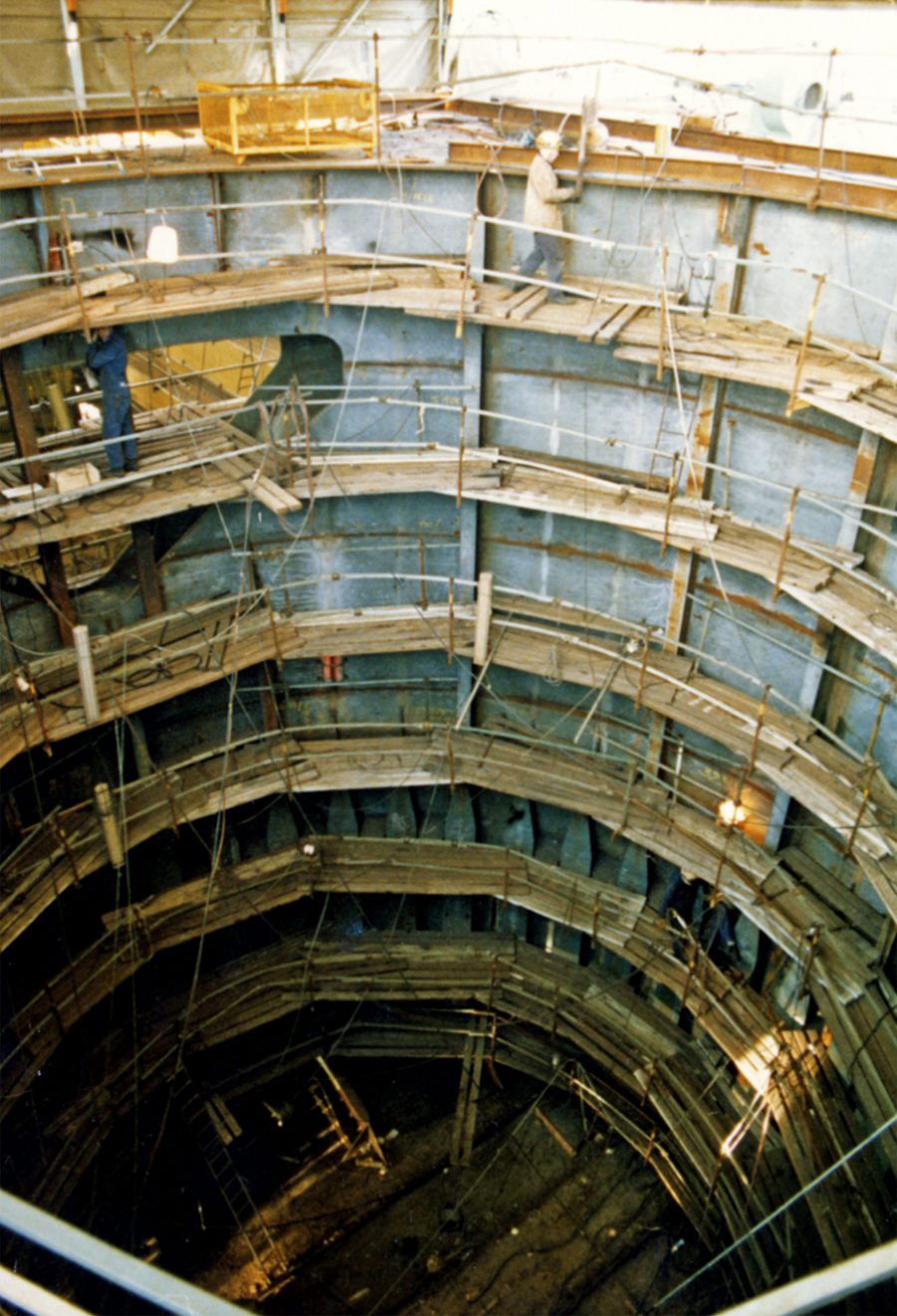
From the topsides lobby, a passenger lift and a 5-ton freight lift run the full height of each shaft. The entire core — lifts, stairs, refuge decks — is ordinary air at ordinary pressure. No divers, no decompression, ever.
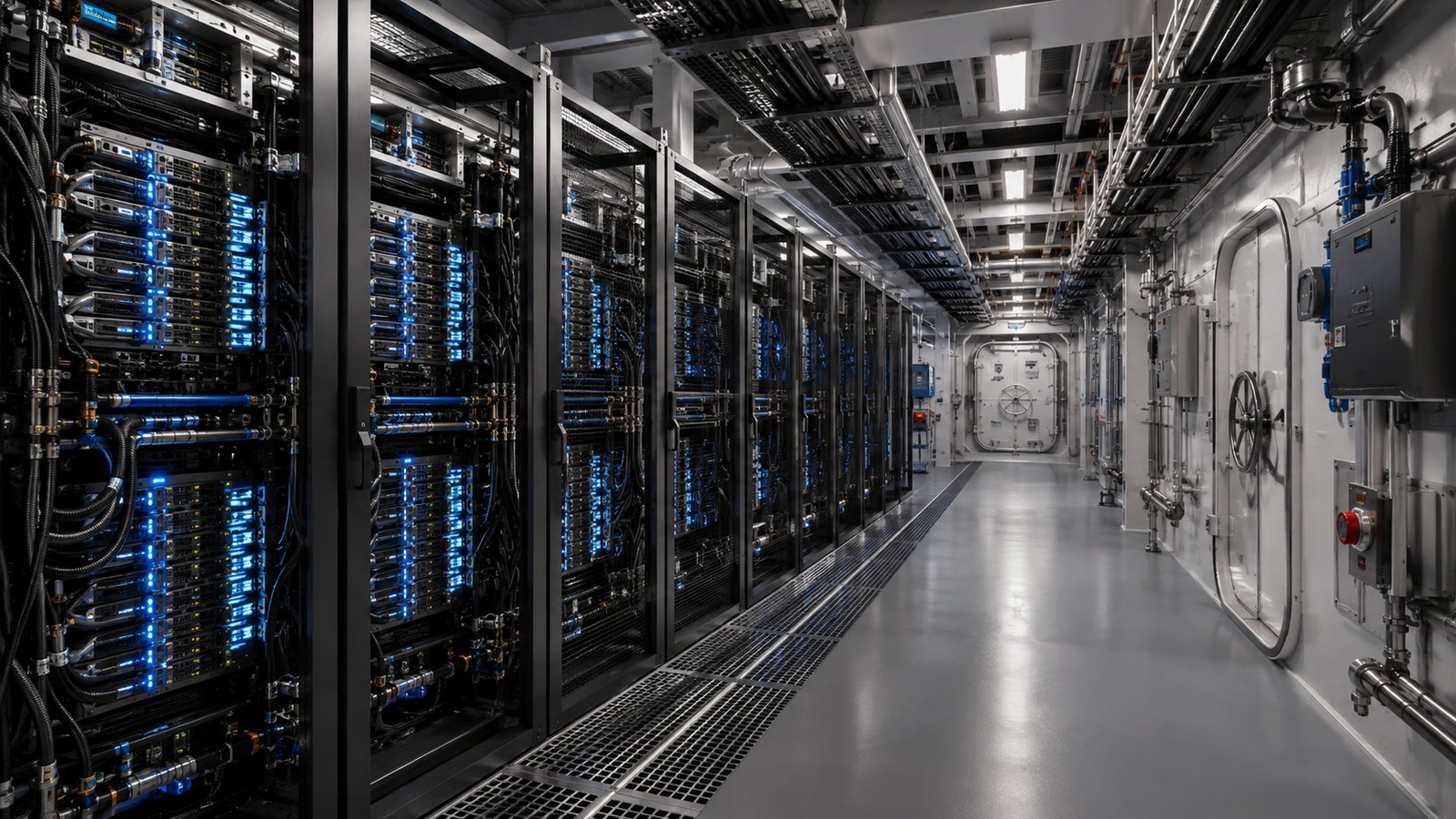
Step off at any deck: liquid-cooled racks ring the elevator core, denser as the shaft widens toward the base — from roughly 1,700 sq ft per deck at the top to 7,500 sq ft at the bottom. Cold plates take the heat straight to the risers you see running the height of the shaft.
The halls beyond the core are sealed in dry nitrogen — no oxygen, so no fire, no corrosion, no dust. On planned maintenance days a technician swings through the airlock with a breathing set; the rest of the year the racks run untouched, and fail roughly eight times less often for it.
At the bottom of the shaft, seawater pumps and hull heat exchangers move the tower’s heat into 50–54 °F ocean — the machinery that replaces an entire chiller yard on land. The freight lift serves this deck too: every pump is swappable without a marine operation.
Every element of a Bluewater tower has decades of service history in another industry. Our work — and our patent-pending system — is the integration.
A 525 ft gravity-based structure descended from ~30 North Sea platforms — slip-formed in a dry dock, towed to site floating, ballasted down in a season. Certified under existing DNV offshore-concrete rules. 75–100 year design life.
No oxygen means no fire, no corrosion, no dust — the regime Microsoft’s Project Natick showed cuts hardware failures roughly eightfold. Technicians work from a one-atmosphere core and enter halls through airlocks on planned maintenance days.
Passenger and 5-ton freight lifts connect the surface deck to every data deck at ordinary atmospheric pressure. Any rack, in minutes, in street clothes — no divers, no decompression, no marine operation to swap a server.
High-voltage DC distribution runs the halls at rack densities today’s grid-tied buildings can’t reach — ready for 120 kW AI racks now and 1 MW-class racks over the structure’s life. Power arrives from onboard reactors or a shore cable; the halls don’t care which.
Closed-loop liquid cooling carries heat from cold plate to hull heat exchanger; the sea does the rest. At 100–300 ft the water holds 50–54 °F every hour of every year — no heat waves, no derating, no evaporation.
Supply reaches the racks at ≈64 °F, returns at ≈95 °F, and leaves through the hull with a thermal plume that disperses within yards. The result is a 1.05 PUE in any climate — and a data center that is, from the shore, perfectly silent. No cooling towers. No fans on a roof. No 85 dB hum for the neighbors, because there are none.
The structure, the halls, and the cooling are identical either way — the power decision stays open until the final investment decision, with no redesign.
Four Xe-100 small modular reactors on the topsides deck deliver 320 MWe — walk-away-safe TRISO fuel, refueled online, sized N-1 so a module outage never touches the halls. The tower becomes its own utility: ≈100 MW of surplus clean power exports ashore through the site’s transmission corridor, a second revenue stream from day one.
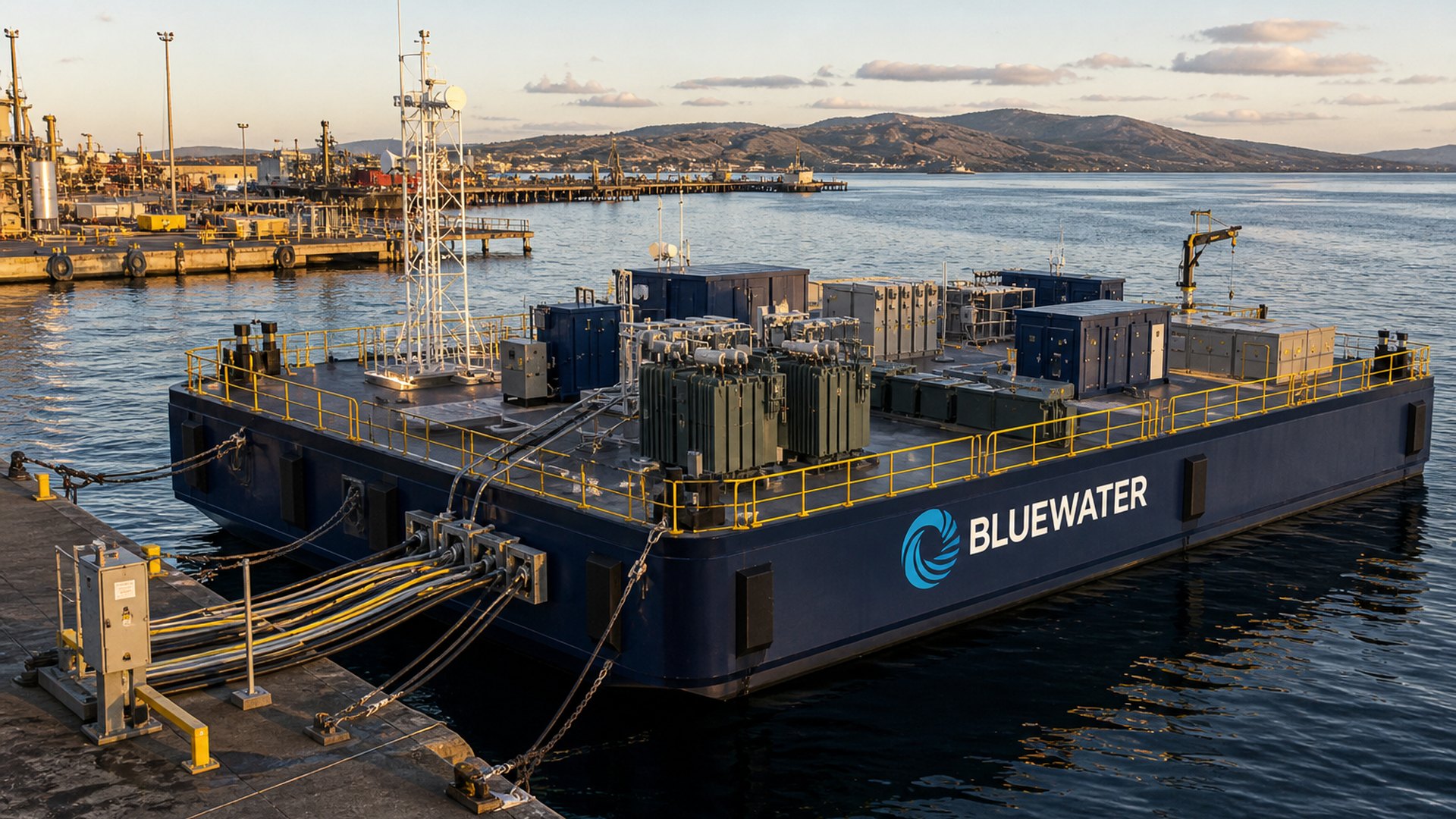
Where policy prefers it, the same cable runs the other way. The tower lands its 220 kV corridor on a retired coastal plant’s existing interconnection — grid rights that already exist, at berths like San Pedro and San Onofre. Day-one capital drops to ≈$2.3B; reactors can be added later without redesign, because the deck space and the electrical architecture are already there.
Replaces 100+ acres of contested metro land — and the rezoning fights that come with it.
Closed-loop cooling rejects heat through the hull. No cooling towers, no evaporation, no refrigerant plant.
Self-powered by onboard SMRs — or landed on interconnection rights that already exist. Either way, no multi-year wait.
50–54 °F water in every season. No heat-wave derating in exactly the hours compute is most valuable.
The loudest data-center complaint on land doesn’t exist 25 miles out. The nearest neighbor is a shipping lane.
Front-end engineering with Dr.techn. Olav Olsen, environmental studies, seabed lease.
Slip-forming in a proven heavy-marine dry dock; halls outfitted and topsides set at the quay.
Single-season float-out, tow to site, ballast-down — standard Condeep practice for fifty years.
All four shaft halls live at arrival; surplus power exports ashore as tenants lease up.
Spheres add capacity 10 MW at a time toward 290 MW — delivered by barge, not by construction site.
Bluewater is raising a Series A to fund front-end engineering, permitting, and control of both sites — the offshore berth and the construction yard — for tower one. A non-confidential teaser is available on request; the full deck and data room follow for qualified investors.
investor@bluewaterdatacenters.com